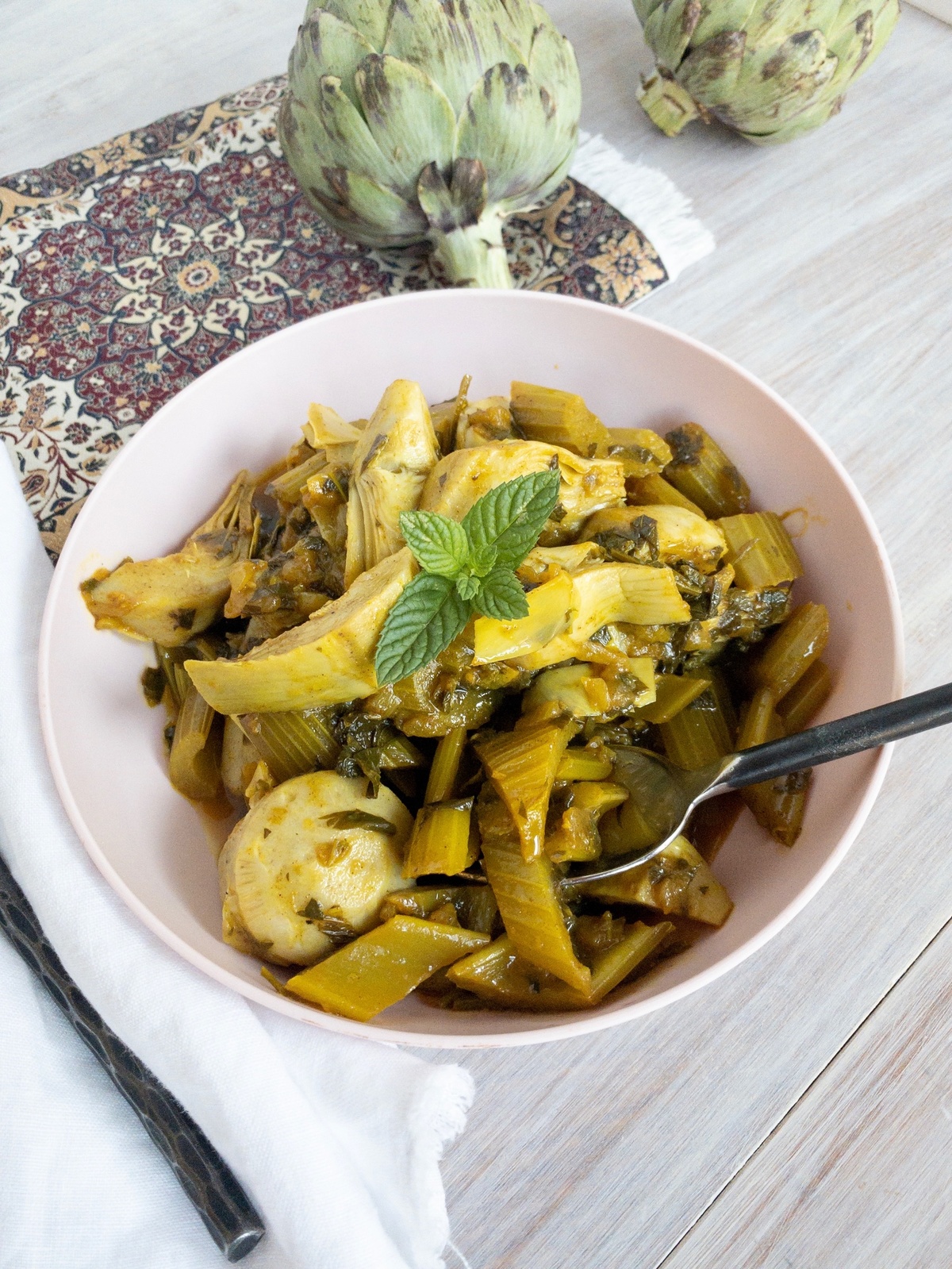
Khoresh Karafs | Persian Celery Stew
Persian Celery Stew is a traditional Iranian dish served with rice. It is a veggie-heavy dish loaded with celery and herbs, normally made with beef or lamb. In the traditional form, it takes hours to braise and simmer. Our modern version cuts out the meat while retaining delicious flavors. The Farsi word for celery is Karafs. Khoresh is the word in the Persian language for stew. Persian Celery and Artichoke Stew, like most Persian stews, is served on top of or alongside rice for main dishes.

Growing up, this dish was a staple and in our dinner rotation. As a doctor, my dad practiced what he preached – he believed that chicken was healthier than red meat. Hence, my mom used to make it with chicken. In my adult modern cooking, I find it delicious with no meat. We enjoy our karafs the most with artichoke hearts.
Khoresht karafs, also known as Persian celery stew, has a sour flavor thanks to the unique ingredient we add, Persian dried lime. To boost the citrusy, sour taste, we love this vegetarian stew with the addition of artichoke hearts. Artichoke and celery pair nicely together. When my mom cooks this stew, she even adds a few splashes of lemon juice to make it more ‘zesty’ (one of her favorite words).
Specialty Persian ingredients:
Dried limes: Submerge dried limes in boiling water until soft. Puncture some holes in the limes once they have become soft – this allows the flavors to seep into the stew. Remove the dried limes before serving. The dried limes are flavor enhancers and not meant to be consumed.
For more Persian ingredients and how to use them, check out the guide How to Stock a Persian Pantry.

The term for artichoke in Farsi is tricky – even my hubby Bob who is much more fluent in the language than I am didn’t know the words for it. Asparagus is called “Kangar Farangi”. As far as I understand, it is not a veggie that is native to Iran. Some Persians refer to it by its easier French name, artichaut (pronounced like ‘artichoe’). Farsi actually has many words with French origins. My dad used to make a hobby of reciting all the similar words like a chant: television, télévision; automobile, automobile; autobus, autobus; maillot, le maillot; telephone, le téléphone…and on and on. Since we all studied French in school here in the U.S., it was his way of encouraging us that we know more Farsi than we realize. That’s it for the etymology lesson. Back to cooking!

Cooking steps:
- Sauté onions, add salt and spices to the onions, and saute until onions are soft, yellow, and translucent
- Add chopped celery and saute for about 10 minutes
- pour in broth, and simmer
- Add the fresh, chopped herbs, cover, and simmer on low for an hour – celery should become very soft
- Add artichoke hearts last and adjust salt
Another variation is to add chickpeas to khoresh karafs for an added vegetable protein, vitamins, and fiber. The fiber in the chickpeas makes it a denser, more filling dish.

Serving suggestion: Khoresht is best served on top of a steaming portion of white Basmati rice. For a foolproof technique to prepare delicious Persian rice, click my post, Preparing Persian Rice in a Rice Cooker. A nice complementary side dish to khoresh karafs and rice is Persian Cucumber Yogurt Dip.
If you love this stew, be sure to try a luscious and iconic Persian stew Khoresh Fesenjan | Persian Pomegranate Chicken!