Persian New Year
In anticipation of the Persian New Year, OvenHug has been featuring primarily Persian cuisine this month.
Persian New Year is the moment that we change seasons from winter to spring. To be precise, it is the exact moment in time of the vernal equinox, when day and night are exactly the same lengths. Iranians use a solar calendar. Remember, this is an ancient culture we are talking about. The year is going to be 1398 – don’t worry, that means close to nothing to me as well.
This brings me to a point that although I was born in Iran and have Iranian roots, I feel American through and through. Sadly, I have no memories of having celebrated Norooz/The Persian New Year in Iran. I was a toddler when we emigrated to Michigan from Iran. At that time our family was more about blending and assimilating to the Western culture than about embracing our roots and our culture.
Living in California and marrying into an Iranian family, I have started embracing our culture better over the years. I now look forward to the tradition of having a 2nd new year, if you will, at this time of year. When you think about it, the first moment of spring is a beautiful time to celebrate a new year. It is very ‘one with nature’. Nature shows us renewal through trees that are beginning to blossom, wildflowers poking their way out after a long, wet winter, and animals (humans included!) feeling happier, more energetic, and frisky.
The time of the Persian New Year here in California (PST) this year is right around 3 pm Wednesday, March 20th. The time and day of the new year vary from year to year falling anywhere between the 19th and the 21st of March due to the solar calendar, and at various times of day or night.
Here are some traditions of Iranian families around the Persian New Year:
- spring cleaning
- purchasing of new clothes and shoes (traditionally this is the one and only time children get new things each year!)
- setting the Haft-seen table with 7 symbolic items that start with the Farsi letter ‘seen’ /words start with the ‘s’ sound. Preparation in conjunction with setting the haft-seen table includes growing sprouts, decorating eggs, and baking sweets
- feasting – herb rice, smoked fish, veggie/noodle soup, herbed omelet
- giving cash gifts to children
As I have hinted at, I only have a surface understanding of this old, rich tradition – that which we’ve emulated in this country. There are parts of this holiday that I have never experienced. For example, jumping over small wildfires (called Char Shambeh Souri). While others that lived in Iran reminisce about this custom I listen with wonder and have no real understanding of what that was like.
Even with my limited experience of this holiday, I grasp the basics. The teacher in me would like to share what I know.
One thing we carry out in our families is setting up the Haft-seen table each year at this time.


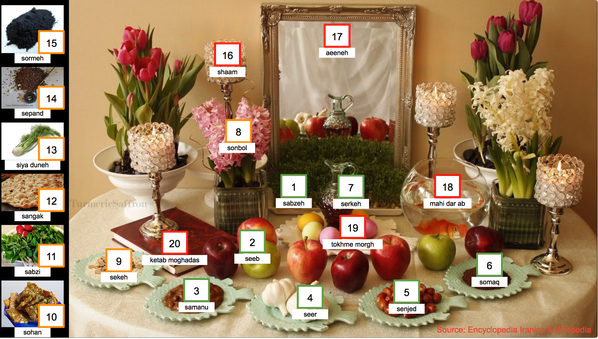
Haft-Seen: 7 Symbolic things that start with the Farsi sound of ‘s’ or ‘seen’
Sib: apple symbolizing beauty
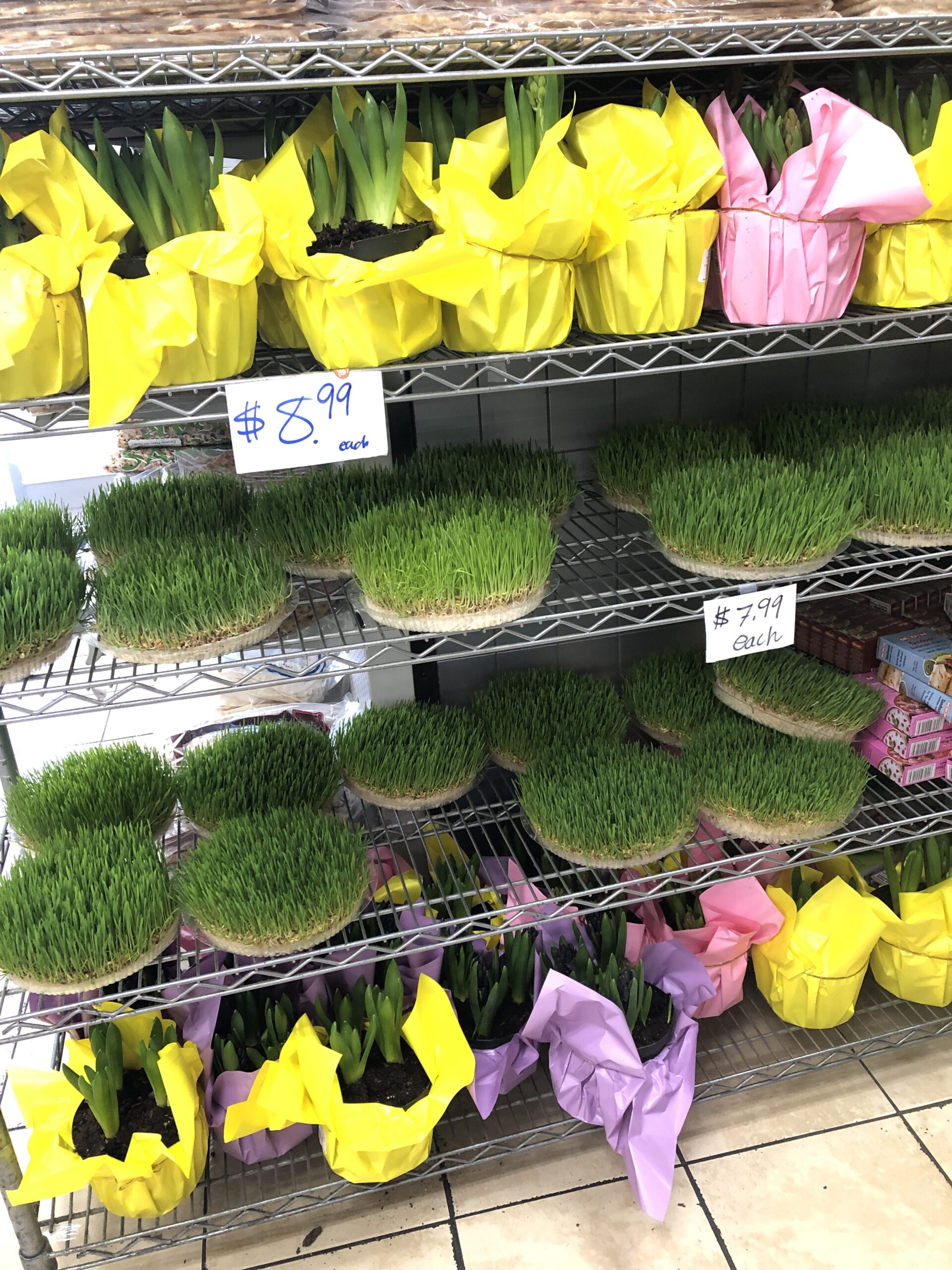
Sonbol: fresh hyacinth flower symbolizing the fragrance and beauty of life
Seer: garlic symbolizing health
Senjed: wild olives symbolizing love
Somagh: sumac representing a spicy life?
Serkeh: vinegar symbolizing aging
Samanou – wheat sprout pudding representing patience, power, bravery
Sabzeh – green sprouts representing growth and life
Sekeh: coins symbolizing prosperity
As you can see the list is longer than 7 things – each family chooses the 7 they’d like to include on the table. The meanings are also open to interpretation.
List of items often found on a Haft-Seen table:
Goldfish in a fishbowl – movement and life
Shirini – sweets for a sweet life
Colored eggs – for fertility
A mirror – for wisdom, reflection and light
Lit candles for enlightenment
A bowl of rose water or orange blossom water for fragrance and sweetness
Book of poetry (Hafez) or holy book (Qu’ran)
Here is a great image of a full Haft-seen that serves as a comprehensive diagram including a few things I haven’t even heard of:
There you have it, friends. A little synopsis of a springtime tradition that has been celebrated for some say 5,000 years!
For a fun and easy way to make colorful eggs for the haft-seen table and to use up leftover nail polish paints, try this DIY project, Marbelized Easter Eggs.